Freight Operations Virtual Assistant
Trained in full-cycle freight operations from dispatch and load coordination to final documentation. Ready to keep your lanes moving with accuracy, consistency, and minimal supervision.
Niche: Freight Broker & Trucking Operations Support focused on repeatable load execution, risk control, and clean documentation, not one-off admin tasks.
- Advanced training in end-to-end Freight Operations and broker support
- Systems-driven approach to load lifecycle, cash flow, and risk prevention
- Able to own recurring operational workflows with minimal oversight
Available for remote freight operations support in US time zones.

Catherine Baculpo
Freight Operations Virtual Assistant
Visualizing freight trucks on highways, warehouse flows, and live route performance. This is how I think about your operation: as a monitored system, not a task list.
Operations Support Built on Real Freight Training
This isn't a general VA who learned freight from a YouTube video. I
completed a structured freight operations training program built
around hands-on simulations of real brokerage workflows 4 covering
the full load lifecycle from first call to final invoice.
My training was designed to mirror what happens inside a freight
brokerage on a busy day: tight deadlines, carrier communication,
documentation backlogs, and shipment exceptions that need fast,
accurate resolution.
Load Lifecycle Management
End-to-end understanding from booking to delivery
Broker-Carrier Communication
Professional, precise, and documentation-backed
Tracking & Issue Resolution
Proactive monitoring with fast escalation protocols
Documentation Workflows
Rate cons, PODs, invoices 4 processed with zero gap
What Sets This Apart
Most VAs support operations. I understand them. The
difference shows up in how I handle exceptions, prioritize tasks, and communicate with carriers 4 without needing to be walked through every step.
Training included:
Simulated load coordination scenarios
Real-time shipment tracking exercises
Documentation processing under deadline pressure
Invoice and billing workflow practice
Core Freight Operations Systems I Run
My work is organized around the full load lifecycle from first tender to final invoice with clear ownership of each operational system.
Load Lifecycle Management
Structured handling from tender → booking → dispatch → POD, with clear checkpoints, timestamps, and documentation controls.
- Standardized intake for new loads
- SLA-based milestones and time windows
- Exception tagging for at-risk loads
Dispatch & Communication
Structured check-calls, driver briefings, and broker updates to keep every party informed before issues escalate.
- Consistent check-in cadence per lane type
- Scripted dispatch notes in TMS/CRM
- Escalation paths for silent or late drivers
Rate Confirmation & Documentation
Guardrails around rate cons, accessorials, BOLs, and PODs so margin and payment are protected before the load is even picked up.
- Rate vs cost checks before dispatch
- Document completeness checklists
- Structured naming and storage conventions
Tracking & Exception Handling
Proactive monitoring with clear rules for what triggers an escalation, who gets notified, and how it is documented.
- Live status boards for in-transit loads
- Predefined responses for common issues
- Root-cause notes for repeated exceptions
Billing & Cash Flow Support
Ensuring every load is billable, properly documented, and tracked through to payment so your cash flow stays predictable.
- Invoice readiness checks per load
- Dispute-prevention documentation
- Simple dashboards for AR follow-up
Simulation Projects: Case-Study Style Operations
Below are structured simulations based on real freight operations patterns designed to demonstrate how I think, decide, and protect your book of business.
Each project follows the same structure: Overview, Role, Workflow, Tools, Key Actions, Problem & Resolution, Outcome, and Key Insight.
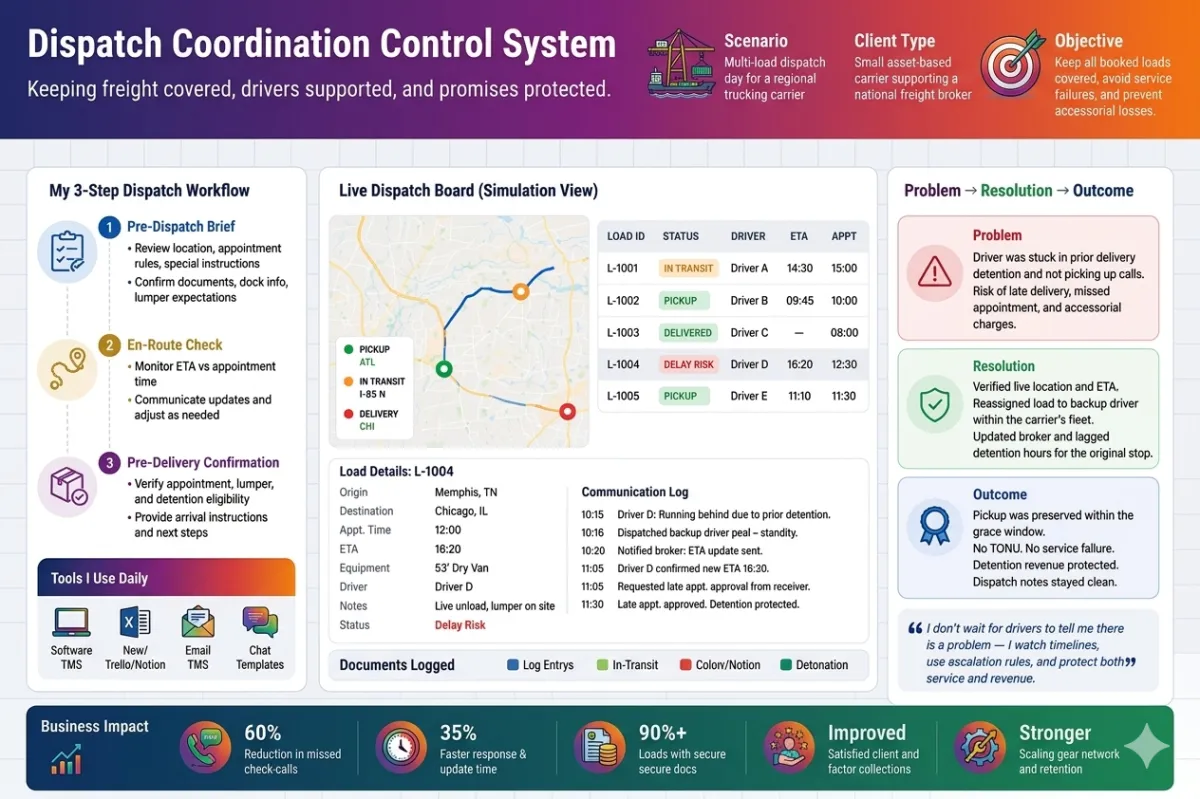
Project 1- Dispatch Coordination Control System
Scenario: Multi-load dispatch day for a regional trucking carrier running dedicated lanes for a freight broker. One driver becomes late and then unresponsive before pickup.
Client Type: Small asset-based carrier supporting a national freight broker.
Objective: Keep all booked loads covered, avoid service failures, and prevent accessorial losses from missed appointments.
My Role: Freight Virtual Assistant acting as operations support, running dispatch boards, coordinating with drivers, and managing broker communication.
Workflow: I standardized a 3-step dispatch flow: pre-dispatch brief (location, appointment rules, special instructions), en-route check (ETA vs appointment time), and pre-delivery confirmation (dock info, lumper expectations).
Tools Used: TMS dispatch board (simulation), shared load sheet in Excel/Sheets, WhatsApp / SMS templates, and email for broker updates.
Key Actions: When the driver became unresponsive, I triggered the escalation playbook: contacted backup driver pool, notified the broker with options (swap truck vs reschedule), and annotated the TMS with time-stamped notes.
Problem & Resolution: The original driver was stuck in prior delivery detention and not picking up calls. I documented timestamps, verified their live location, then reassigned the load to a backup driver within the carrier's fleet. I aligned a new ETA with the shipper, updated the broker, and logged the detention hours for the original stop so they could be billed correctly later.
Outcome: Pickup was preserved within the grace window, no TONU, and no service failure with the broker. Dispatch notes stayed clean, and the carrier captured detention revenue instead of losing it in the chaos.
Key Insight: I don't wait for drivers to tell me there is a problem - I watch timelines, use escalation rules, and protect both service and revenue.
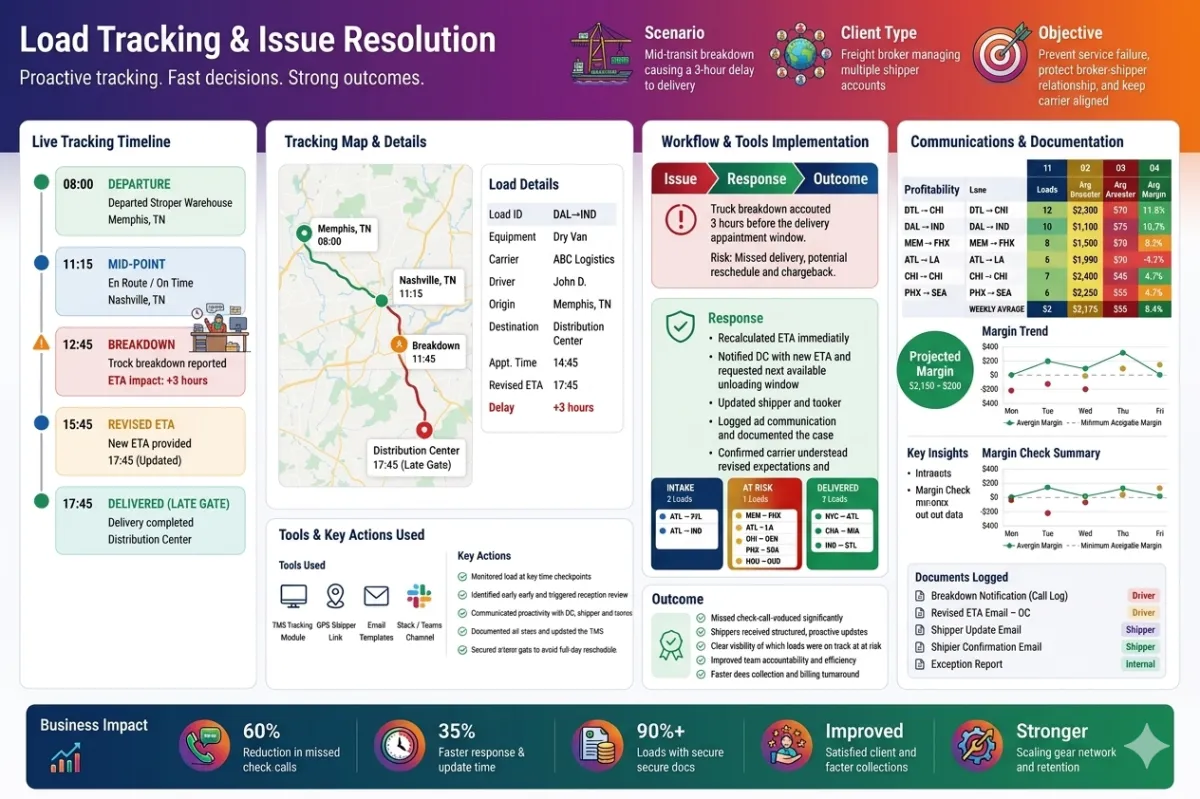
Project 2- Load Trucking & Issue Resolution
Scenario: Broker-managed dry van load from a shipper's warehouse to a distribution center. Mid-transit, the truck experiences a breakdown 3 hours from delivery with a strict appointment window.
Client Type: Freight broker managing multiple shipper accounts.
Objective: Prevent a service failure at the distribution center, protect broker-shipper relationship, and keep carrier aligned on expectations.
My Role: Tracking and exception handling specialist, responsible for live monitoring, communication, and documenting the event trail inside the TMS.
Workflow: I ran a time-based tracking routine: check-calls + GPS pings at departure, mid-point, and 90 minutes before ETA. Any variance beyond 30 minutes triggered an exception review.
Tools Used: TMS tracking module, GPS tracking link, email templates for shipper/DC, and an internal Slack/Teams channel for escalation.
Key Actions: Once the breakdown was reported, I immediately recalculated ETA, documented the cause, and prepared three options for the broker: push appointment, arrange resolution truck, or rebook with penalty risk analysis.
Problem & Resolution: A roadside repair ETA made it impossible to hit the original delivery time. I notified the DC receiving contact proactively with the new ETA and requested the next available unloading window. In parallel, I updated the shipper and broker, logged all communication, and confirmed that the carrier understood revised expectations and any potential charge exposure.
Outcome: Delivery was shifted to a later gate time the same day, avoiding a full-day reschedule and additional layover. The shipper received structured updates, and the broker could defend against any unfair chargebacks using the documented trail.
Key Insight: I turn unexpected events into controlled exceptions by pairing live tracking with disciplined, time-stamped communication.
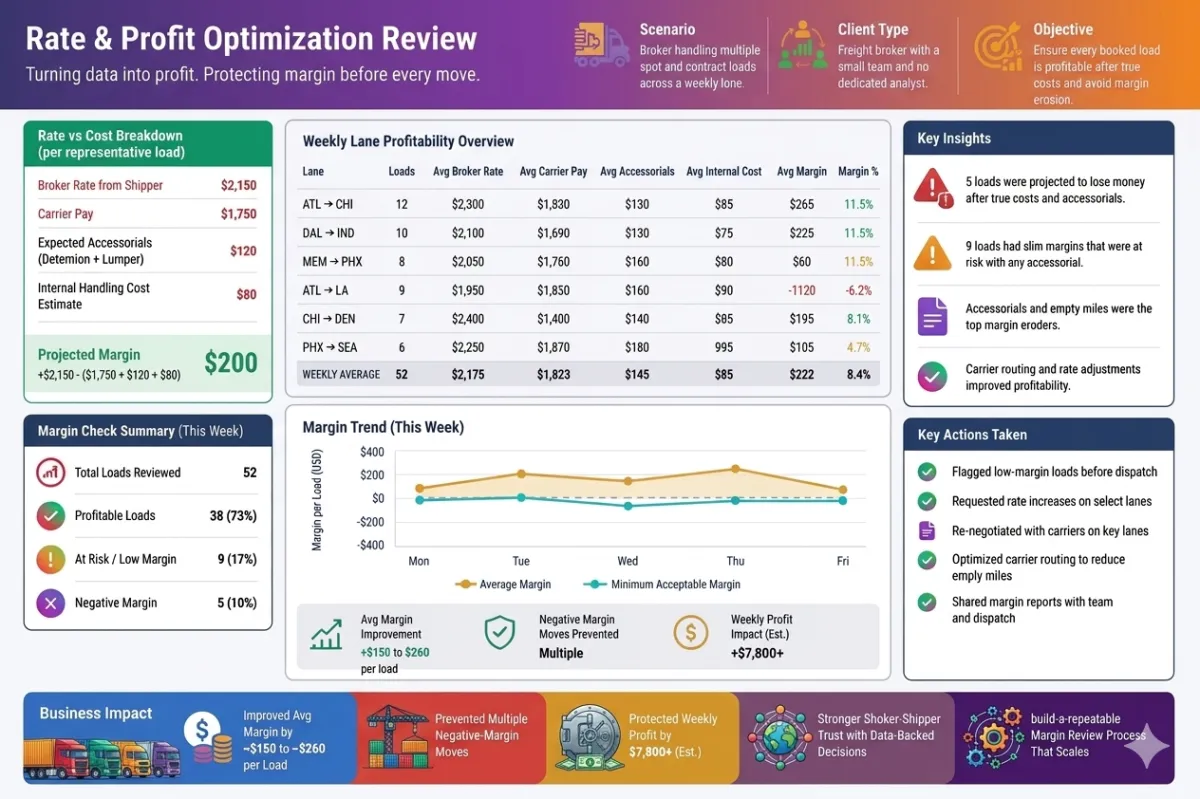
Project 3- Rate & Profit Optimization Review
Scenario: Broker handling multiple spot and contract loads across a weekly lane. Some loads appeared profitable at a glance, but accessorials and empty miles were quietly eroding margin.
Client Type: Freight broker with a small team and no dedicated analyst.
Objective: Make sure every booked load is profitable after true costs, and flag anything that risks negative margin before it moves.
My Role: Operations-focused analyst, reviewing rate confirmations, estimating expected costs, and highlighting margin leaks before dispatch.
Simple Rate vs Cost Breakdown (per representative load):
Broker rate from shipper: $2,150
Carrier pay: $1,750
Expected accessorials (detention + lumper): $120
Internal handling cost estimate: $80
Projected margin: $2,150- ($1,750 + $120+ $80) = $200
Workflow: I built a margin-check template in Excel/Sheets that compared rate, carrier pay, predicted accessorials, and internal handling cost per lane.
Tools Used: Excel/Sheets, TMS rate confirmation data, historic accessorial reports, and dispatcher feedback.
Key Actions: I flagged loads where projected margin fell below the minimum threshold and proposed either a rate increase request or carrier re-negotiation.
Problem & Resolution: Several loads were being accepted with very slim margin where a single accessorial would wipe out profit. I summarized these in a short report, and the broker used my findings to push for modest rate increases on select shippers and negotiate more efficient carrier routing.
Outcome: On the example lane above, average margin improved from ~$150 to ~$260 per load by adjusting rate and carrier choice. Across the week, this prevented multiple negative margin moves.
Key Insight: I treat every load as a small P&L - not just a file to move from point A to point B.
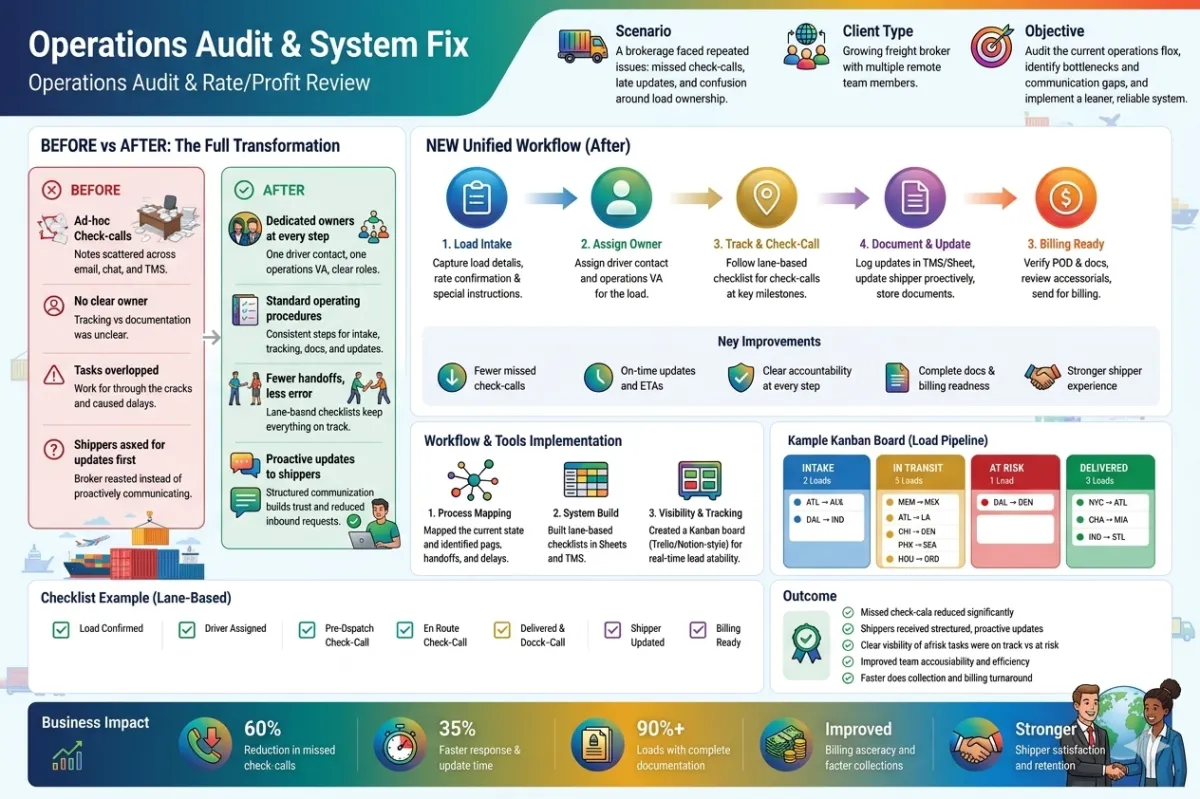
Project 4-Operations Audit & System Fix
Scenario: A small brokerage was experiencing repeated issues: missed check-calls, late updates to shippers, and confusion around who owned which part of the load lifecycle.
Client Type: Growing freight broker with multiple remote team members.
Objective: Audit the current operations flow, identify bottlenecks and communication gaps, and implement a leaner, more reliable system.
My Role: Freight operations consultant and virtual operator, mapping the workflow and designing clear handoffs, checklists, and dashboards.
Before vs After Snapshot:
Before: Check-calls handled ad hoc; notes scattered across email, chat, and TMS. Shippers often asked for updates before the broker could provide them.
Before: No clear owner for tracking vs documentation; tasks overlapped and sometimes fell through completely.
After: Defined roles: one primary dispatcher for driver contact, one operations VA (me) for tracking, documentation, and shipper updates.
After: Standard operating procedures for load intake, tracking cadence, document handling, and billing readiness.
Workflow & Tools: I mapped the current state using a simple process diagram, then rebuilt it into a lane-based checklist system using Sheets, the TMS, and a shared Kanban board (Trello/Notion-style) to visualize each load's stage.
Outcome: Missed check-calls were reduced significantly, shippers received structured updates, and the broker had a clear view of which loads were on track vs at risk.
Key Insight: I don't just plug into your existing process - I help you see it, simplify it, and then run it consistently.
How I Work as a Freight Operations Partner
My role is to run the operational systems that keep your freight moving and your profit protected not to wait for instructions on individual tasks.
1. System-Driven Workflow: I start by understanding your lanes, customers, and service promises. From there, I map the load lifecycle into clear stages and checklists so every move follows the same reliable structure.
2. Proactive Communication: I set expectations for how and when I will communicate with drivers, brokers, carriers, and shippers. Updates are sent before they are requested, and exceptions are flagged early with options, not problems.
3. Attention to Detail Where It Matters: I pay close attention to appointment times, commodity details, accessorial rules, and documentation requirements. The goal is clean execution and clean paperwork so you don’t lose money after the fact.
4. Profit and Risk Protection: I look at every load through an operations and margin lens. That means watching dwell times, identifying cost leaks, and making sure rate confirmations, detention, and accessorials are handled deliberately, not by accident.
5. Continuous Improvement: As patterns emerge (recurring delays, documentation gaps, repeated questions from shippers), I suggest simple process improvements revised scripts, new checklist steps, or better dashboards and then I own those updates going forward.
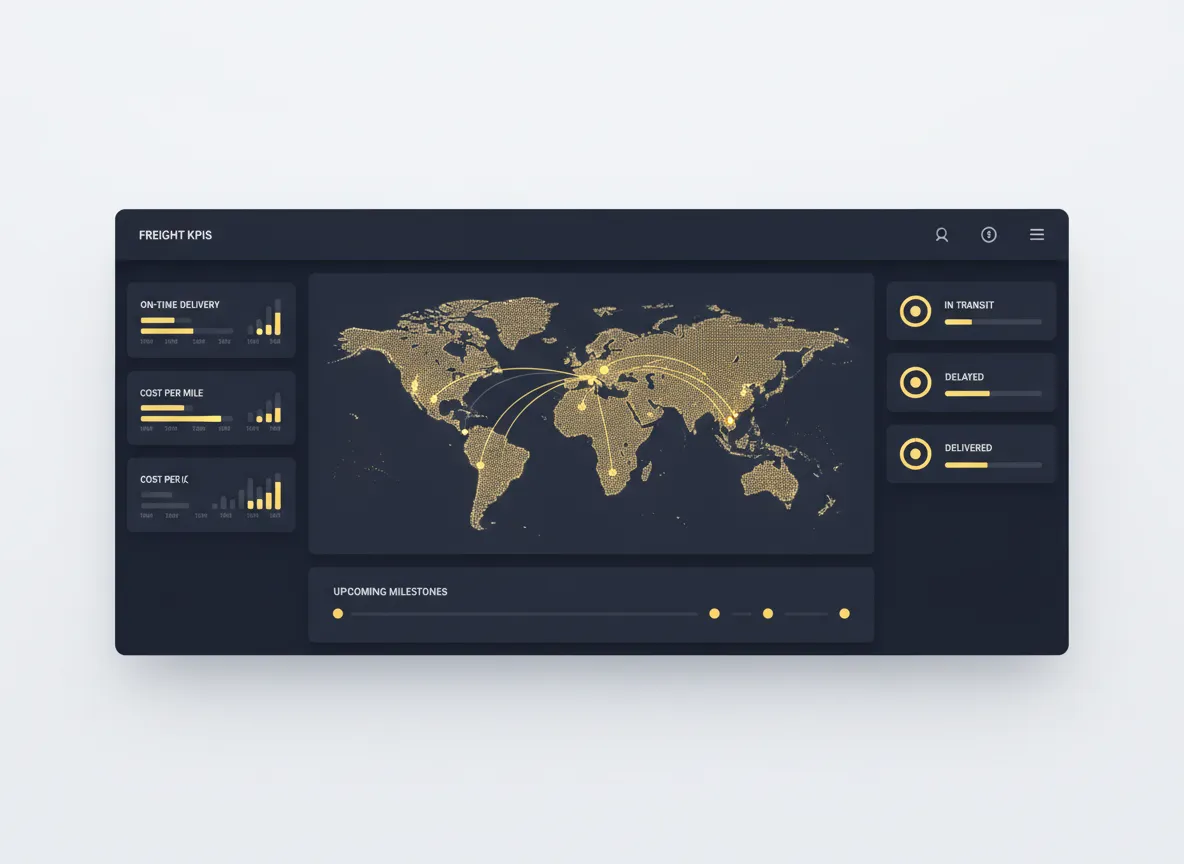
Think of me as the person watching your operations dashboard: I track the numbers, watch the timelines, and keep the flow moving while you focus on relationships and strategy.
Tools & Systems I Operate In
Comfortable adapting to your stack. The important part is the operational logic, not the specific software.
Transportation Management Systems (TMS) – Load entry, status updates, carrier assignment, and documentation management within TMS platforms standard to freight brokerage operation.
Excel / Google Sheets – load tracking logs, carrier rate metrics, check call records, and billing reconciliation. Built and maintained with structured, audit-ready formatting.
Email, SMS, WhatsApp – Professional carrier outreach, rate con distribution, exception notifications, and internal status reporting. Organized, documented, and followed to resolution.
Load Boards- carrier sourcing, lane posting, and market rate research using standard freight load boards to support coverage and capacity decisions.
Project & task tools – Trello, Asana, Notion-style boards for load stages
Tracking tools – GPS links, app-based tracking, manual check-call schedules
Documentation Management – Google Drive, OneDrive, or Dropbox and shared file systems used to organize rate confirmations, PODs, invoices, and billing packets for clean, accessible record keeping.









TMS & Dispatch
Load boards, status updates, check-call logs, and lane templates.
Analytics & Margin
Rate vs cost analysis, lane performance, and exception frequency.
Docs & Billing
Rate cons, BOLs, PODs, and invoice-ready packets for factoring or direct billing.
Ready to Support Your Freight Operations
If you want someone who can own the day-to-day flow of loads, protect profit, and keep customers informed without needing reminders, we should talk.
- You gain a systems-minded freight operator, not a general VA.
- Your loads are tracked, documented, and billed in a consistent way.
- You reduce firefighting and can focus on growth, sales, and relationships.
- Your team has clear processes, cleaner communication, and fewer surprises.
Location / Setup: Remote Freight Virtual Assistant with advanced freight operations training, ready to integrate into your existing systems and workflows.


